There is a moment in most conversations about ageing and exercise when someone says, "it is all downhill after fifty." It is a comfortable sentence because it asks nothing of the listener. It is also wrong in an important way. Muscle mass and strength do decline with age, but the rate is not fixed, and a large part of the decline is explained by disuse rather than chronology.

The research on resistance training in older adults is unusually consistent. It improves strength, balance, bone density and metabolic health, and it reduces the risk of falls. The interesting questions are practical: how to start, how hard to work, and how to avoid the injury that turns a good intention into a six-month setback.
Why muscle matters more after 50
Muscle is not just a performance organ. It is a metabolic one. It stores glucose, supports joint stability and provides the reserve that keeps people independent when illness or surgery interrupts normal life. After 50, the natural decline accelerates, and the loss is often invisible until a fall, a hospital stay or a flight of stairs exposes it.
This is why strength training is not cosmetic. A person who can rise from a chair without using their arms, carry their own shopping and recover balance after a stumble has a different trajectory from someone who cannot. Those capacities are trainable, and they respond to relatively modest doses of resistance work.
The three pillars
Most successful programmes for people over 50 rest on three pillars, in this order.
- Strength. Progressive resistance for the major movement patterns: squat, hinge, push, pull and carry. Two sessions a week is enough to start.
- Balance and stability. Single-leg work, controlled changes of direction and simple standing balance drills. These reduce fall risk more than strength alone.
- Cardiovascular work. Brisk walking, cycling or swimming. Not the focus of this article, but not optional either.
Notice what is missing: high-intensity interval training, complex olympic lifts and long sessions in a commercial gym. Those can come later, if at all. The first job is to build a habit that survives a busy month.

How heavy is heavy enough
The old advice for older adults was light weights and high repetitions. It was well intentioned and largely wrong. Light weights build endurance, not much strength. To stimulate muscle, the load has to be challenging enough that the last few repetitions are genuinely hard.
A practical rule: choose a weight you could lift eight to twelve times with good form, and stop with two repetitions still in reserve. If you can do twenty comfortable repetitions, the weight is too light. If your form collapses at six, it is too heavy. Progress by adding a small amount of weight or one repetition at a time, not by jumping to a new machine.
| Goal | Repetitions | Sets | Sessions per week |
|---|---|---|---|
| General strength | 8-12 | 2-3 | 2 |
| Bone density focus | 6-10 | 3 | 2-3 |
| Beginner confidence | 10-15 | 2 | 2 |
| Maintenance in a busy week | 6-12 | 2 | 1 (full body) |
Programming a week
The simplest effective structure is two full-body sessions with at least one rest day between them. Each session covers a squat, a hinge, a push, a pull and a carry. That is five exercises, three sets each, and it fits into forty minutes once the habit is established.
An example week looks like this: Monday, goblet squat, Romanian deadlift, incline press, row, farmer carry. Thursday, the same pattern with slightly different variations. Add a ten-minute walk on the other days. That is the whole programme for the first two months.
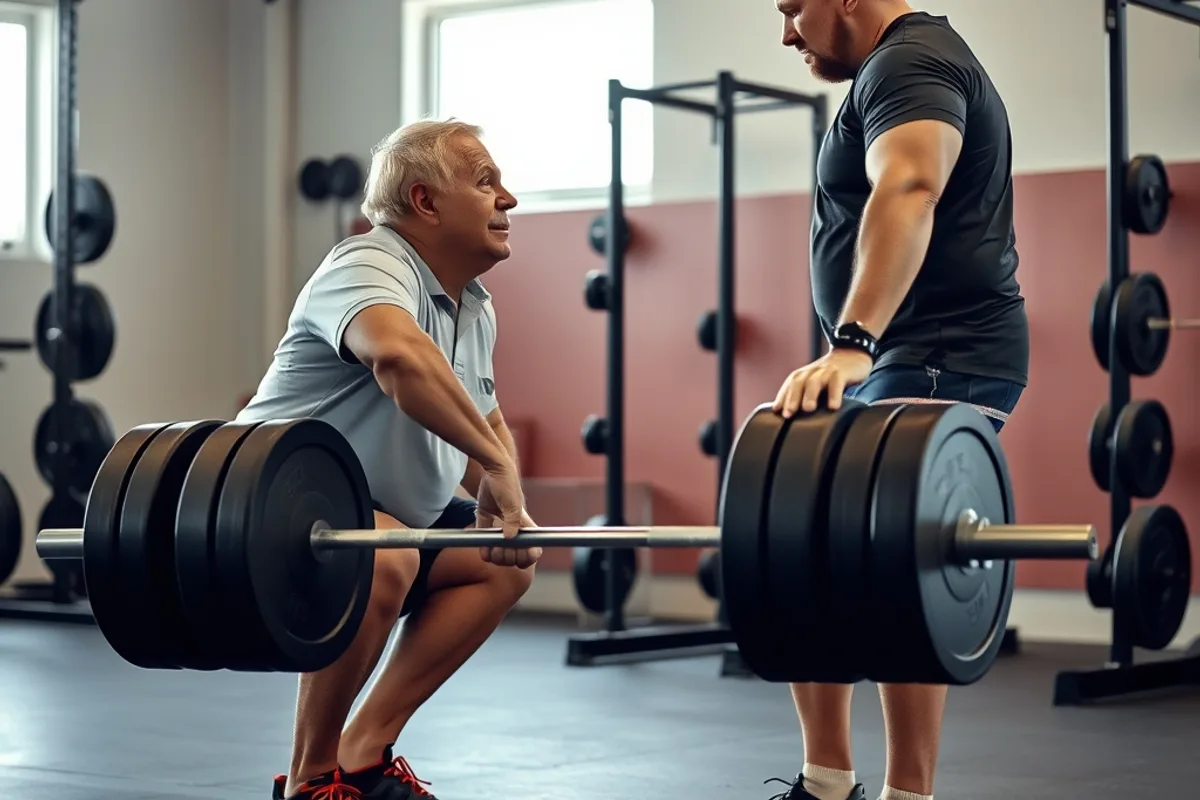
After eight to twelve weeks, progress becomes harder. This is normal. At that point, a coach or a well-designed app can help with variations, but the principles do not change: progressive load, enough recovery and consistency over intensity.
Protein and recovery
Strength training creates the stimulus; food and sleep create the adaptation. After 50, the muscle-building response to protein is blunted, which means distribution matters. A common recommendation is roughly 1.2 to 1.6 grams of protein per kilogram of body weight per day, spread across three or four meals rather than concentrated at dinner.
That is not a prescription for everyone, particularly people with kidney disease, who should follow clinical advice. For most healthy adults, the practical version is simple: include a palm-sized portion of a protein food at each main meal, and do not skip breakfast.
The limiting factor is rarely the programme. It is the week you get busy, skip two sessions and decide the whole thing was not for you.
The injury fear
The fear of injury keeps more people out of the gym than the actual risk does. Resistance training has a good safety record when load is progressed sensibly and technique is coached. Most injuries in this age group come from three sources: doing too much too soon, copying a programme designed for a 25-year-old, and ignoring pain that is clearly not muscle soreness.
The distinction is worth learning. Muscle soreness arrives the next day, is diffuse and improves with movement. Joint pain is sharp, local and often worse the next morning. The first is part of the process. The second is a signal to change something.

Getting started this month
- Book one session with a coach. Learn the five patterns. One hour is enough to prevent months of error.
- Start lighter than you think. The first two weeks are for technique and habit, not progress.
- Write it down. A notebook is a better progress tracker than memory.
- Protect the calendar slot. Treat it like a meeting with someone you respect.
- Expect a slow start. Strength gains in the first month come mostly from coordination. Visible change takes longer.

The honest promise is not a transformation. It is a different trajectory. People who train consistently through their fifties and sixties tend to keep more muscle, better balance and more independence than those who do not. That is not a guarantee, but it is a reasonable bet, and the cost is two sessions a week.